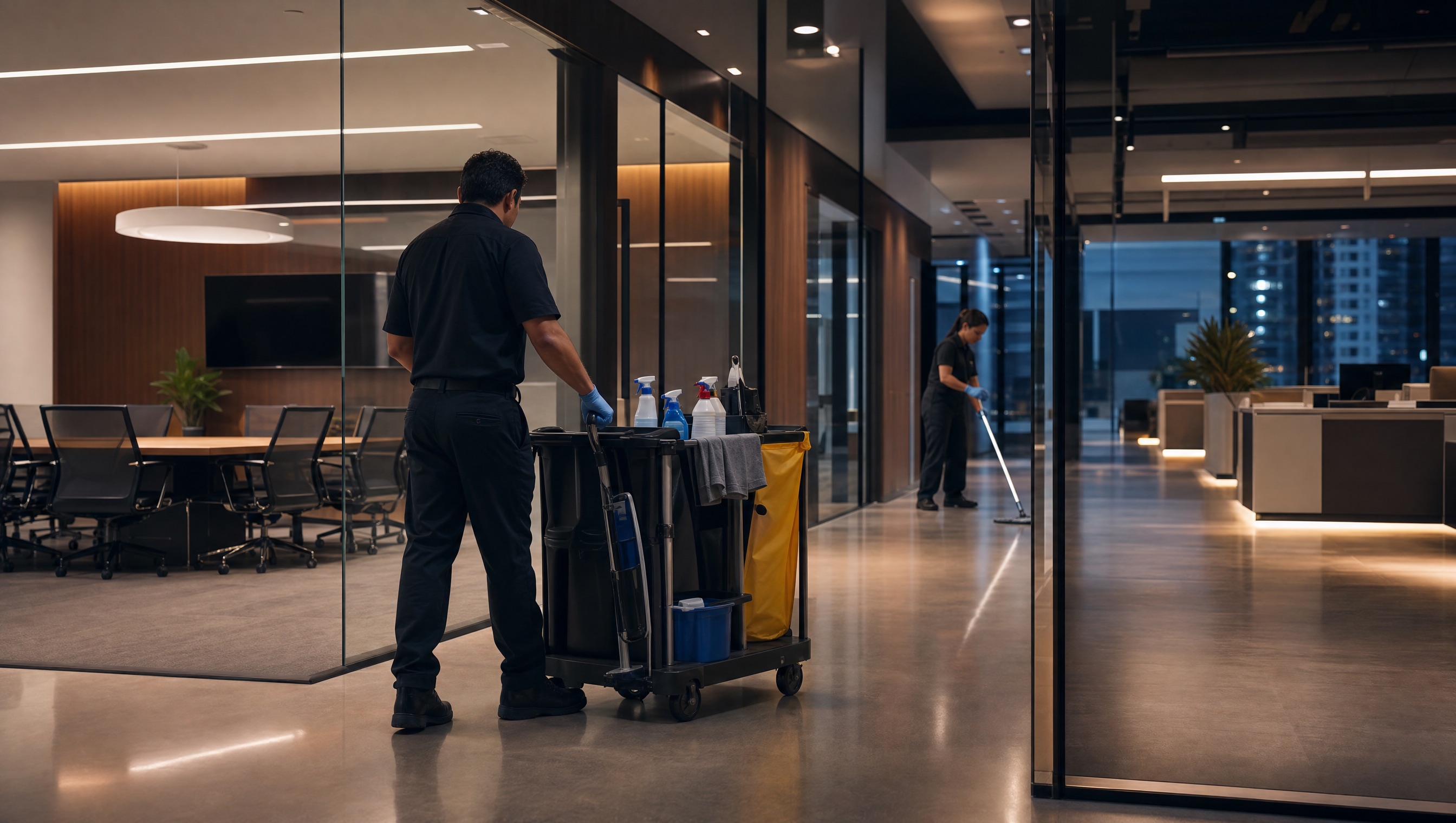
"Should we keep the cleaning in house or outsource it?" is a common question in commercial real estate operations, and it is often poorly answered. Most analyses are written by vendors selling outsourcing or by in house facility managers defending their headcount. Neither is honest.
This piece gives you a real decision framework. The honest answer: it depends. But the variables that should drive the decision are knowable, and you can run the analysis yourself in an afternoon.
The short answer
If you have a smaller footprint with one or a few sites, outsourcing is often the simpler and lower cost choice, because you skip hiring, supervising, equipping, and covering a team yourself. If you have a large portfolio with a dedicated facility operations team and existing labor infrastructure, in house can be competitive. Between those is where the analysis matters.
The honest comparison
What in house cleaning actually costs
The line items most analyses miss:
- Wages: Hourly pay for each cleaner, plus overtime when someone is out or the work runs long.
- Payroll taxes: The employer share of payroll taxes, which you pay and file on every paycheck.
- Workers' comp: Premiums depend on the job class and your state. Ask your insurance broker what cleaning staff would cost you to cover.
- Benefits: Health coverage, paid time off, and any other benefits you offer, plus the work of running them.
- Supervision: Someone has to schedule, train, and check the work. When supervision is thin, QA tends to drift.
- Supplies + chemicals: Chemicals, liners, paper, and soap. Usage varies with building type and traffic.
- Equipment: Floor machines, vacuums, carts, ladders, and scrubbers up front, plus maintenance, repair, and replacement over time.
- Training: Safety and chemical training, plus any rules your building requires, repeated for every new hire.
- Turnover: Recruiting, onboarding, and payroll setup every time someone leaves. Cleaning roles can turn over often, so this cost repeats.
- Insurance: General liability for the work, on top of workers' comp.
- Management: Facility manager time spent on cleaning oversight (scheduling, performance management, vendor management for supplies). Often understated in analyses because the facility manager already exists.
- Coverage gaps: Sick days, vacation, missed shifts. In house operations without a relief pool either run short staffed or pay overtime; both are real costs.
What outsourced cleaning actually costs
An outsourced quote should roll most of the costs above into one all inclusive price: wages, payroll taxes, workers' comp, benefits, supervision, equipment, supplies, training, turnover, and insurance. What that price is for your building depends on the factors in our guide to what drives commercial cleaning cost.
What outsourcing pricing usually does NOT include:
- Floor care cycles (strip/wax, carpet extraction, terrazzo refinishing), typically separate project pricing
- Post construction or emergency cleans, separate project pricing
- Day porter coverage if not specified in the base contract
- Supplies beyond cleaning chemicals (paper products, soap, trash bags, sometimes pass through, sometimes excluded)
The side by side comparison
Here is where each cost category lands under each model:
| Cost Category | In house | Outsourced |
|---|---|---|
| Wages | You pay every hour, including overtime | In the vendor's price |
| Payroll taxes | You pay and file them | In the vendor's price |
| Workers' comp | Your policy, your claims | Vendor's policy; ask for a certificate |
| Benefits | You provide and manage them | In the vendor's price |
| Supervision | You hire or assign a supervisor | Vendor supervisor; ask how often they visit |
| Supplies + chemicals | You buy, store, and track them | Often included* |
| Equipment | You buy, repair, and replace it | Vendor owns and maintains it |
| Training | You build it and repeat it for each new hire | Vendor trains; ask for training records |
| Turnover | You recruit and onboard each replacement | Vendor absorbs it; ask for their turnover rate |
| Insurance (liability) | Your policy covers the work | Vendor carries it; ask to be named additional insured |
| Management oversight | Your team runs the program day to day | You manage one vendor relationship |
| Coverage gaps | You cover sick days and vacations | Vendor covers absences; ask how |
*Supplies sometimes pass through with markup; ask the vendor.
To run the math, put a number on each in house line using your own payroll, insurance, and purchasing records. Then set that total next to written vendor quotes for the same scope. For smaller footprints, the in house list is often longer than people expect. For larger portfolios, in house can spread fixed costs over more space.
When the math favors in house
In house starts winning on TCO when:
- Your portfolio is large and the sites are close together. Fixed supervision and equipment cost amortizes across more volume.
- You already have a robust facility operations team with HR and management capacity to absorb cleaning oversight without new hires.
- Specialty environments (clean rooms, hospitals, classified facilities) where compliance work never stops and you can build that capacity in house at scale.
- Low cost of living metros where local labor is cheaper than vendor pricing reflects.
- You have strategic reasons to keep work in house, confidentiality (legal, classified), unionization considerations, brand experience reasons.
The variables most analyses miss
Real cost of turnover
Cleaning roles can turn over often. Each time someone leaves, you pay again for recruiting, training, lost productivity, and extra supervision while the new person learns the building. Check your own HR records for how often your cleaning roles turn over. Outsourced operations absorb this cost in their pricing, but they ALSO have scale advantages in recruiting and training that an in house operation doesn't. Ask any vendor for their turnover rate and how they cover absences.
Real cost of supervision
In house operations often undersupervise because the supervisor cost is hard to allocate. The result is gradual QA drift. Vendor operations have supervision baked into their pricing (whether they execute it well is a different question, see our vendor evaluation checklist).
Optionality cost
In house operations are sticky. You can't scale down quickly without layoffs. You can't reallocate to seasonal needs. Outsourced contracts preserve optionality, which has real value during business uncertainty.
Specialty scope handling
In house teams handle their core scope well but struggle with specialty (post construction cleans, biohazard response, floor refinishing, deep cleans). Many in house operations end up bringing in specialty vendors anyway, which means they're paying for both in house AND outsourced capacity. Worth accounting for.
The hybrid model many large operations actually run
Many enterprise facility operations end up with a hybrid:
- In house day porters for visible, customer facing coverage during business hours (lobby, restroom rounds, executive floors)
- Outsourced nightly janitorial for the bulk of the scope
- Specialty vendors for floor refinishing, carpet extraction, post construction, biohazard
This isn't a failure mode; it's often the right answer. Day porter coverage in house gives you customer facing control. Outsourced nightly absorbs the scale, supervision, and turnover. Specialty vendors handle exception work.
The decision worksheet
Run this analysis on a spreadsheet:
- Calculate fully loaded in house labor for your facility
- Add the line items above (equipment, supplies, insurance, HR, supervision, management, coverage)
- Get 3 honest outsourced quotes against the same scope (see our RFP guide)
- Compare totals, and compare what you'd give up on optionality, supervision quality, and turnover absorption
Then make the decision honestly. The right answer isn't "always outsource" or "always in house", it's "match the model to the portfolio."
Want help running the numbers?
Schedule a Walkthrough and we'll walk through your specific facility, including the honest analysis of whether outsourcing is the right answer. We're a commercial cleaning company; we have a bias. But the math is the math, and we'd rather tell you "stay in house" than win a contract you'll regret in 6 months.